Pravar OS is an agentic operating system for wealth and asset management firms. It is the governed platform every Pravar AI agent runs on, and it sits above the systems a firm already uses.
An AI agent is software that does a task, not only answers a question. Here is why we built the foundation first, and what it does that separate tools cannot.
In short:
- An agentic operating system gives every AI agent the same rules, data protection, memory and record, the way a laptop's operating system serves every app.
- Separate AI tools each repeat their own guardrails, data handling and audit trail. An operating system provides them once.
- One built for wealth also knows households and mandates, so what an advisor learns in one place reaches the plan, the scenario and the report.
The problem
Why do AI tools that work in a pilot struggle in production?
Most AI arrives as a feature. One tool summarizes documents, another drafts meeting briefs, a third queries the data warehouse. Each has its own guardrails, data handling and audit trail. That can work in a pilot. Several of them side by side in production is harder
23%
Scaling AI agents
Of organizations say they are scaling an agentic AI system somewhere in the enterprise
39%
Experimenting with agents
Say they have started experimenting with AI agents.
Source: McKinsey, The state of AI in 2025. We think scaling depends less on better models than on a better foundation, one that keeps every agent's work measured, guarded and observable.
The idea
What is an agentic operating system?
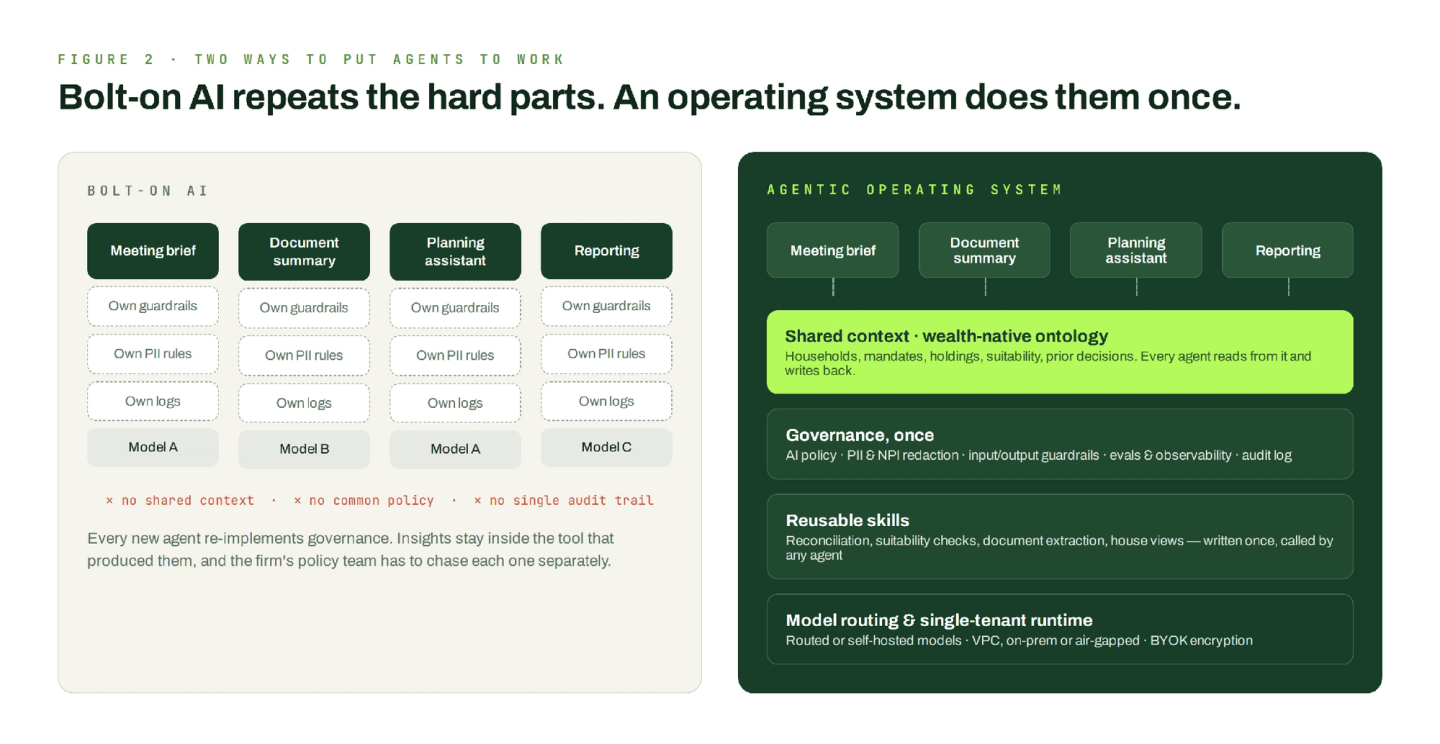
Think of the operating system on your laptop. Every app relies on it for security, storage and smooth running, and no app builds those basics itself. An agentic operating system does the same for AI agents. Engineers sometimes call it an agentic harness.
It gives every agent one foundation: rules about what it may do, protection for client data, a shared memory of what the firm knows, proven skills to draw on, and a record of everything it does. Agents then work like apps on one platform, not separate products that each must be bought, secured and supervised.
The contrast
How is an operating system different from bolt-on AI?
- Who can use it?
Bolt-on: each tool has its own logins and settings. Operating system: roles set once by the firm. - Where does client data go?
Bolt-on: wherever each tool sends it. Operating system: personal identifiers are removed before a model sees them. - Who approves the output?
Bolt-on: whoever notices. Operating system: escalation to a person is built into every agent. - Can compliance review it?
Bolt-on: one log per tool, if it is kept. Operating system: one record across every agent.
Pravar OS
What does Pravar OS do?
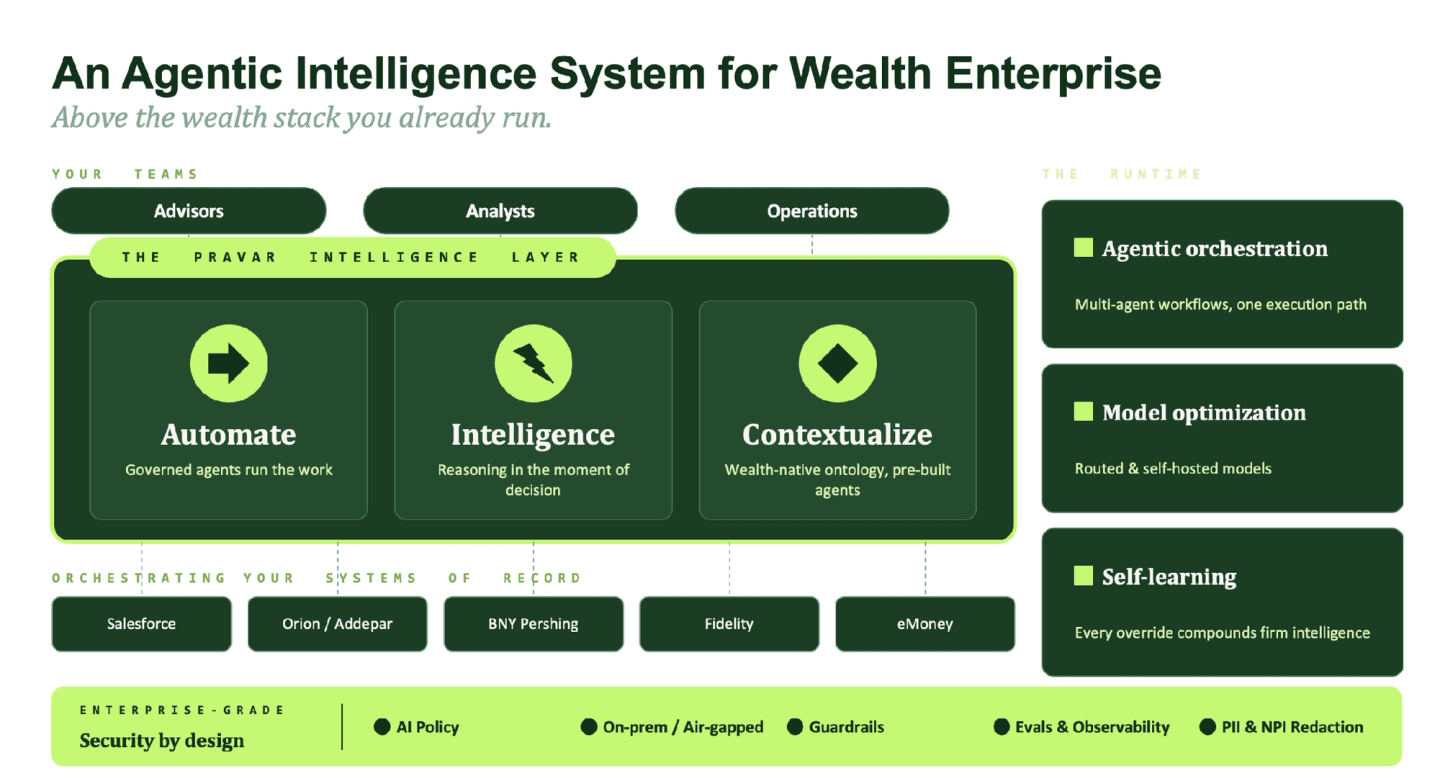
Pravar OS is the system on which Pravar runs every capability for wealth and asset management firms. It sits above the CRM, portfolio platforms, custodians and planning software a firm already uses and connects them into one working whole. It applies the firm's AI policies, voice and guardrails to every interaction and keeps a shared memory of what the firm knows.
Reason 1: governance
Why should governance be written once?
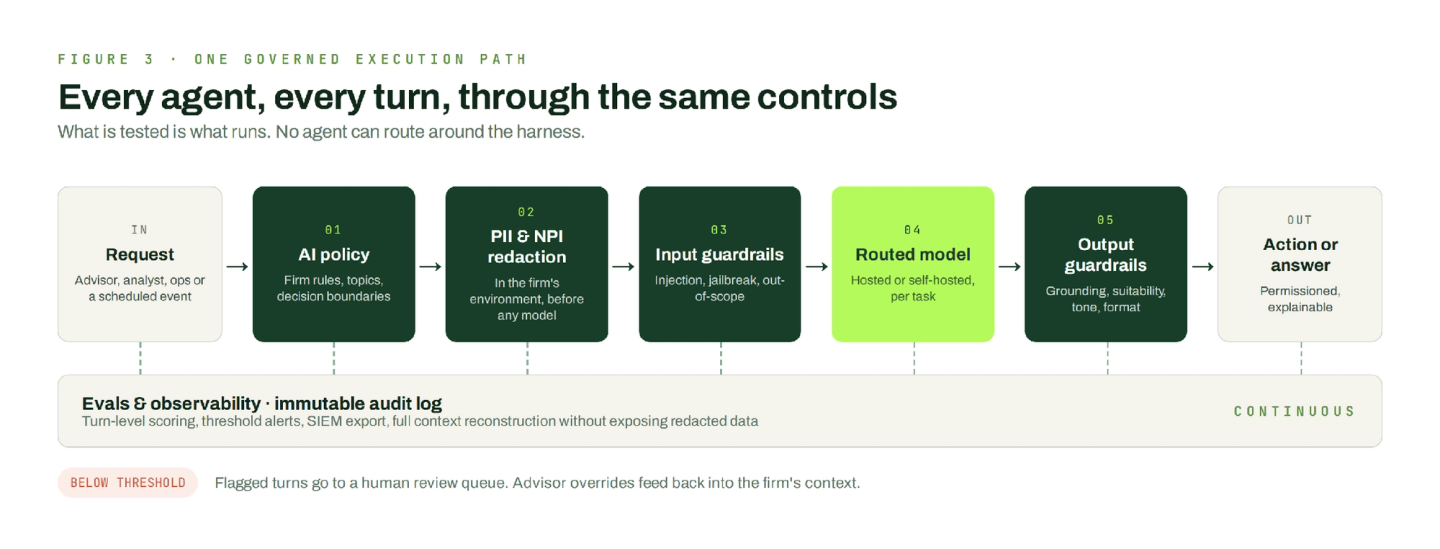
When controls live inside each agent, governance is rebuilt with every new tool and drifts with every policy change. In the operating system, the firm's AI policy is loaded once and enforced at inference time, the moment a model is asked something, on every input and output.
Escalation to a person is built into the runtime. A policy change becomes a versioned configuration change, not a development project.
The SEC's fiscal 2026 examination priorities say staff will review how firms describe their AI, and whether their policies supervise its use (SEC, page 17).
Reason 2: Client Data
How is client data protected before it reaches a model?
Personal and nonpublic information is redacted inside the firm's own environment before any model sees it, whether or not a vendor or developer remembers to. Every agent shares the foundation, so every security decision is shared too: single-tenant deployment in a private cloud, on-premises or air-gapped, with customer-managed keys. The fifth agent does not need a fifth security review.
Bans do not fix this. An Investment Adviser Association panel warned that outright bans may drive shadow AI: an advisor pasting client notes into a personal chatbot the firm cannot see (IAA, June 2026).
Reason 3: audit trail
Why does one execution path give one audit trail?
Bolt-on tools are usually tested once, before purchase. In the operating system, guardrails and evaluations sit on the path that serves production, so what is tested is what runs, and weak answers are flagged for review. Every turn is logged in a tamper-evident record that can be reconstructed for an examiner without exposing redacted data.
Rule 204-2(a)(7) requires records of certain written communications. MoFo says firms should consider whether they capture AI output used in client conversations (MoFo).
Reason 4: speed and cost
Why is each new agent faster and cheaper than the last?
With policy, redaction, evaluation and integrations already in place, a new agent is mostly a matter of defining the work. That is why we can bring a first production agent live in about twelve weeks. Firms can also switch to better or cheaper models without rewriting an agent.
Reason 5: the household
How does an operating system understand a household?
Pravar is built on a wealth ontology, a shared map of households, mandates (the investment rules agreed with each client), holdings, goals and suitability, so agents reason the way advisors do. It orchestrates the systems firms already trust, including Salesforce, Orion, Addepar, Pershing, Fidelity and eMoney, instead of adding another silo. That matters: 69% of surveyed advisors name limited integration between disconnected tools as the biggest barrier to getting value from technology (a Cerulli survey, as reported by Advisor Perspectives, Feb 2026).
Reason 6: the client lifecycle
How do insights travel across the client lifecycle?
An advisor learns in a review that a client's daughter is marrying next spring. In most firms that stays in the meeting summary. It never reaches the financial plan, where it should change a cash-flow assumption, or the simulations, where it should change a liquidity scenario.
Few separate tools can close that gap, because none owns the space between tools. The operating system does. Every agent reads from and writes back to one permissioned household context, so Tuesday's insight is in the plan on Wednesday.
Reason 7: skills and memory
How do skills and memory compound?
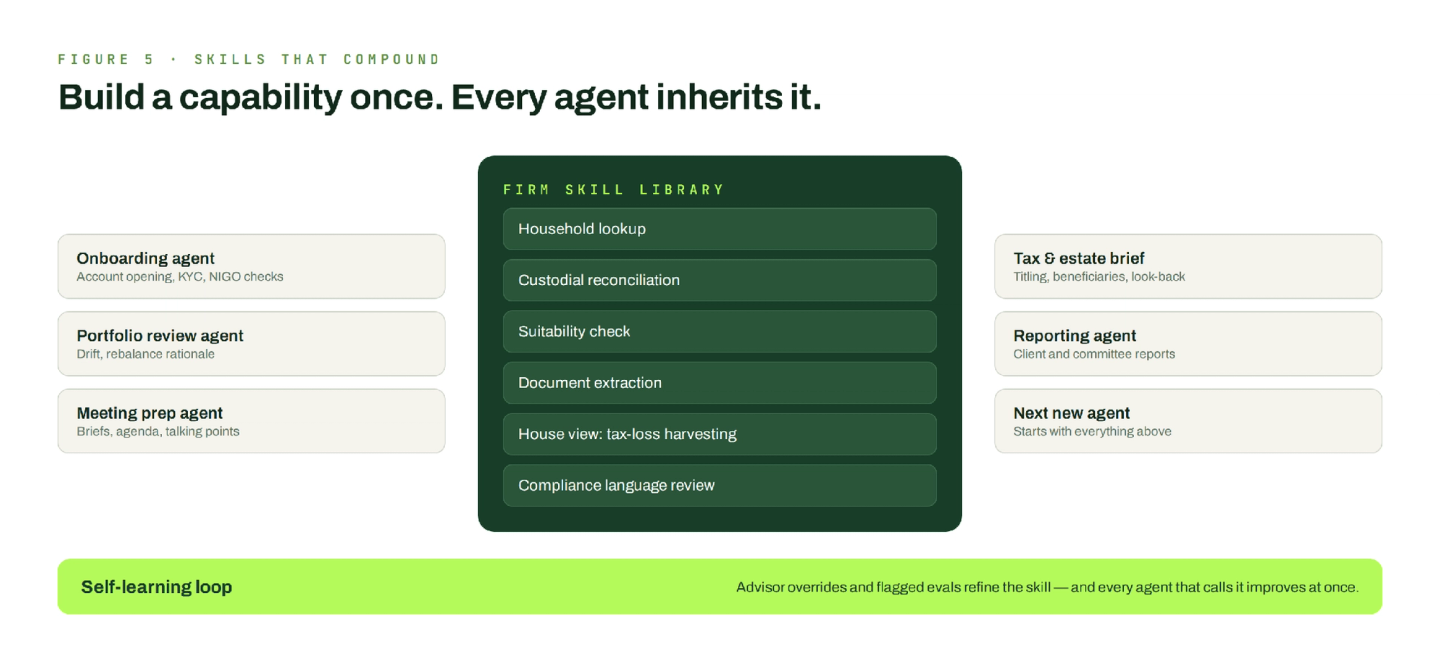
A capability built once, such as custodial reconciliation or a house view on tax-loss harvesting, becomes a skill any agent can call. Every advisor override refines it, and every agent using it improves. The record also keeps client knowledge with the firm when an advisor retires or leaves. Only 6% of advisors planning to retire within ten years have a fully documented succession plan (Kestra and Bluespring Wealth Partners survey, via PLANADVISER, July 2025). Kestra and Bluespring commissioned the survey and sell to advisors.
Our bet
Why build the operating system first?
Building the operating system first is the harder road. We think advantage increasingly lies in orchestration, governance and context, not in any single model. Reliable, compliant AI needs a strong foundation, and we believe in investing in the right one, even if it sits under the hood.
See Pravar OS running on your own systems. Book a demo.
What is an agentic operating system?
A foundation that gives every AI agent in a firm the same rules, client-data protection, memory, skills and audit record, so agents work like apps on one platform.
How is it different from separate AI tools?
Each separate tool carries its own guardrails, data handling and logs, and the firm must buy, secure and supervise every one. An operating system provides those once.
Does Pravar OS replace a firm's CRM or portfolio system?
No. It sits above them, connects them and applies the firm's AI policies to every interaction.