Most RIAs contact clients on a calendar, and in our view that puts the order backwards. A review at set intervals cannot know that a large withdrawal, a business sale or an heir's milestone has landed since the last one, and a long stretch with no contact can pass unseen. Proactive engagement starts from the event instead, and the event is the reason to call.
In short:
- 42% of high-net-worth clients say they have had to restate their goals to the same firm more than once (Capgemini, 2026).
- Among affluent US investors who expect an inheritance, 27% would keep their parent's advisor (Cerulli, 2025).
- The fix is a short weekly list: households ranked by signal, each with the reason attached, and the advisor deciding who to call.
What clients say
What do clients say they lack?
In January 2026 Capgemini surveyed 6,510 high-net-worth investors worldwide, and we read the answers as a description of a service that does not remember. Only 17% said the advice they receive feels frictionless and tailored to their situation, and 42% said they had restated their goals and preferences more than once to the same firm (Capgemini, World Wealth Report 2026, p. 18).
42%
Restated their goals
Have had to restate their goals and preferences multiple times to the same firm
17%
Tailored advice
Say their advice feels frictionless and tailored to their individual situation
We would read the survey with some care. Three quarters of respondents hold $5 million or more, a wealthier group than the typical RIA client base, and Capgemini sells wealth consulting.
Capgemini points to structure rather than carelessness: 60% of executives admit their firm lacks a unified view of the client, and relationship managers lose a large share of their time to operational tasks (Capgemini, p. 18 to 19). A firm can usually say what a client owns. It is far less likely to know what has changed.
The gap
Why does calendar-based service fall short?
Because most of an advisor's week is not spent with clients. Kitces research finds that a typical planner spends about 20% of working time in client meetings and 45% on behind-the-scenes work such as meeting prep and planning analyses (Kitces, Sept 2022). Kitces told FA Magazine that closing the gap with the most successful advisors takes two to four more meetings a week rather than a rebuilt calendar (FA Magazine, July 2026). The open question is which meetings those should be.
The signals
Which signals tell an advisor who needs attention?
We would start with four signals:
- A large outflow. A transfer-out request on a household.
- A quiet year. No contact for a long stretch.
- A business sale. One that shows on a public registry, for example.
- An heir approaching an age that matters.
The last of these deserves more attention than it usually gets. Cerulli projects that $124 trillion will transfer through 2048 (Cerulli, Dec 2024), yet among affluent US investors who expect an inheritance, only 27% say they would keep the managing advisor. Cerulli describes the window to extend the relationship as brief and says the care must be ongoing and proactive (Cerulli, Sept 2025). Most firms agree in principle that family meetings and regular communication across the family are a key best practice (Cerulli, Dec 2024).
The routine
What does a weekly routine look like?
- Rank. List the week's households by signal. Ten is plenty.
- Attach the reason. For each, note the signal and where it came from.
- Decide. The advisor reviews the evidence and chooses who to call.
- Record. Log the call and the next action.
- Review. At the end of the week, check what was missed.
Illustrative scenario. Take a household with $8.82 million behind it and a $1.10 million transfer-out request that is seven days old. In a signal-led week that request sits at the top of the advisor's desk with the date, the amount and the destination, and the suggested action is to call before it settles. The prep brief is already written, and both the alert and the approval go to the audit trail. This is a diagram of an intended workflow, not a customer result.
The payoff
Do clients who feel heard refer more?
Kitces research on referrals points the same way from the other direction. Advisors need clients to feel the value they receive, which means value has to be both created and communicated, and practices that use a client service calendar to show their ongoing work had referral-driven growth 1.1 points higher (Kitces, Sept 2026).
Keep that in proportion, though. Referrals are the most used marketing tactic among advisors, yet firms with standout growth draw only 25% to 35% of new clients from them. We read referrals as a result of good service, not as the plan.
The division of work
Where does AI help, and where does the advisor decide?
AI can read the signals and rank the households, and the advisor decides who to call. We think a system is only worth trusting if it shows the signals behind each prompt and where each came from, so the advisor weighs the evidence instead of accepting a score, and if it proposes anything it drafts for approval before it is written to a system. Compliance should be able to follow the same trail: the signal, the recommendation, the draft and the approval.
Our approach
How Pravar approaches this
We built Pravar for Advisors to start the week with the relationships that need the advisor most, and to say why. It reads more than 100 signals from inside the firm and beyond it, then tells the advisor which households need attention. Each prompt shows the signals behind it and where each came from, and each item is proposed for approval before it is written to any system.
The first screen sorts what needs attention into three bands: what costs something if it waits a day, what has a few days of slack and what can wait. Each line carries its reasoning, so a churn risk says a client has been silent for 51 days and suggests a market-update note or a short call, and a life event says a client's company was acquired, a payout is expected within 60 days and no meeting is booked.
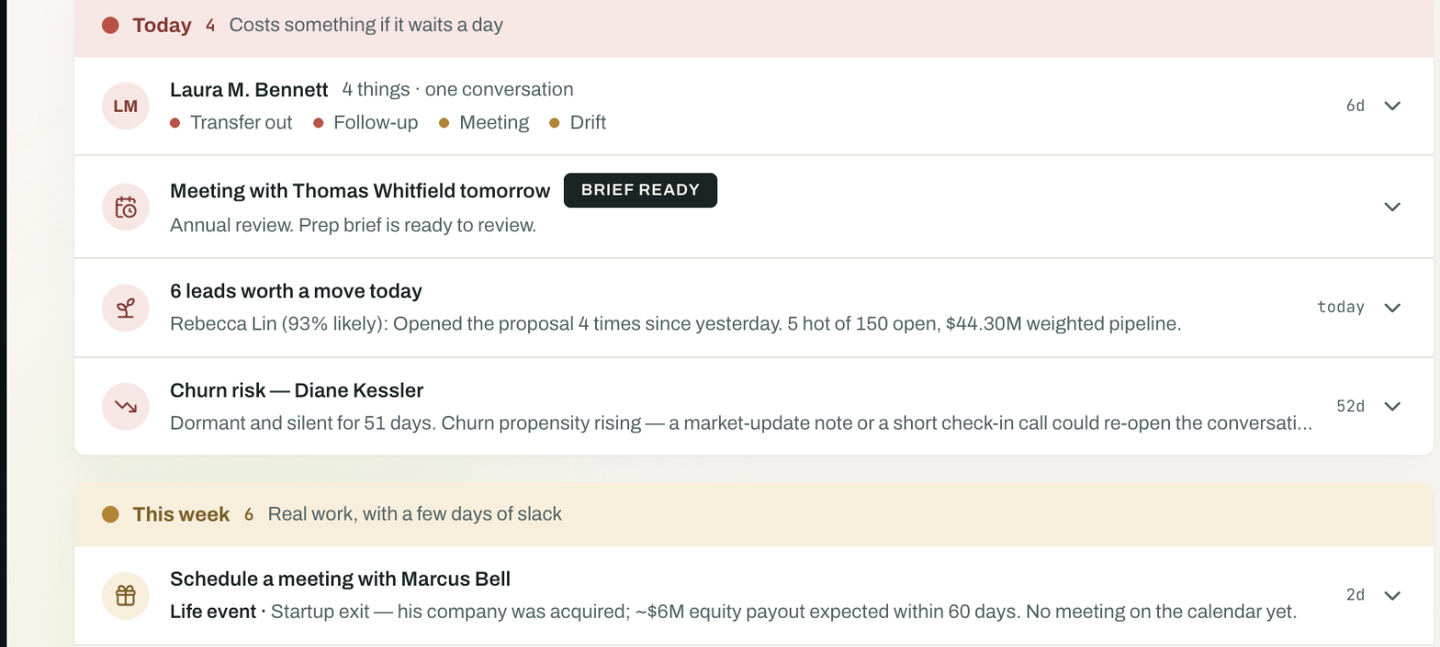
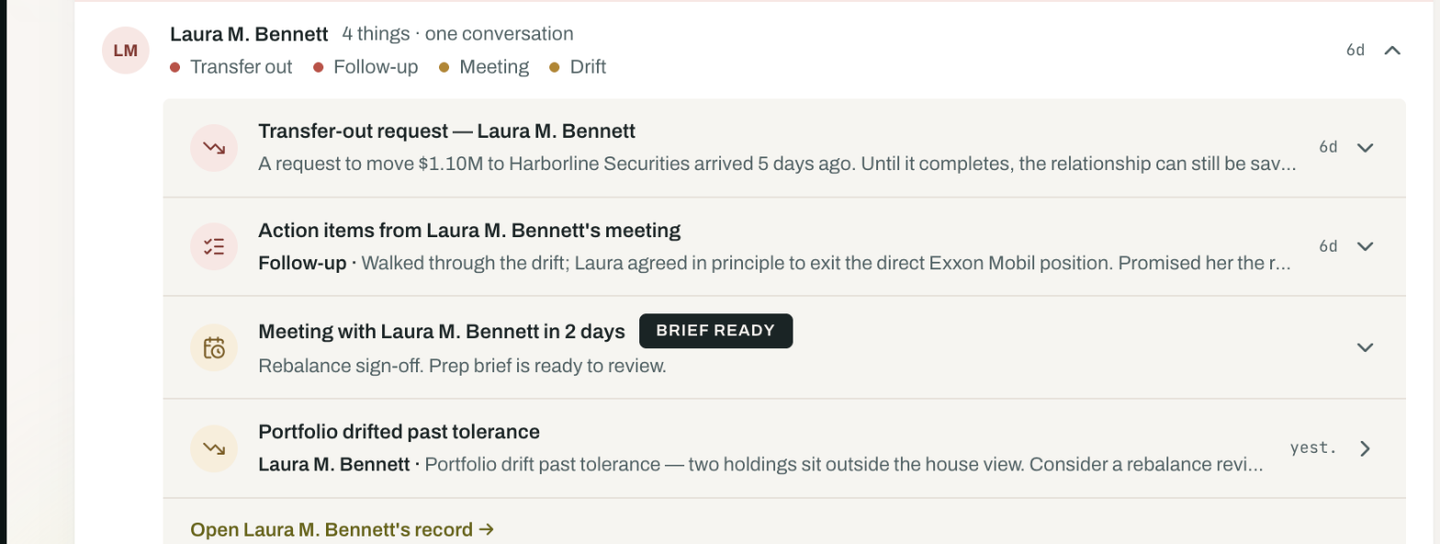
Related items are grouped by client, so one household with a transfer-out request, a follow-up from the last meeting, a meeting with its brief ready and a portfolio that has drifted shows up as one conversation and not four separate tasks.
It runs on our platform, which sits above the CRM, portfolio and planning systems a firm already runs, and every recommendation, draft and approval leaves a record the firm can review.
See Pravar working inside your company.
What is proactive client engagement?
Contacting a client because something changed, such as a large outflow, a business sale or an heir reaching a key age, rather than only on a fixed calendar.
Does it replace calendar reviews?
No. Calendar reviews stay, and signals decide which relationships get attention first.
Do clients who are heard stay longer?
The research here does not measure that directly. Cerulli finds heirs rarely stay unless care is ongoing and proactive, and Kitces links referrals to clients seeing the value they get.