Advisors spend more of their week preparing for client meetings and following up than sitting in them, and in our view that is the best place to start with AI. A good brief tells the advisor what changed since the last meeting, what the client is likely to raise and where the portfolio has drifted from the plan, and it closes with what to ask.
AI can assemble that brief from the CRM, the portfolio system, the plan and the last conversation, which is the pulling-together an advisor would otherwise do by hand. The advisor still checks the sources and makes the call, and that is the arrangement we would insist on.
In short:
- Advisors spend about 36% of their time on meeting prep, planning analyses and follow-up, and about 20% in meetings (Kitces).
- 42% of high-net-worth clients have had to restate their goals to the same firm, and a good brief carries stated goals forward (Capgemini, 2026).
- The advisor still checks the sources and makes the call.
Why it matters
Why does meeting prep matter?
Because it is where the week goes, with a typical advisor spending almost 36% of working time on meeting prep, planning analyses and follow-up against about a fifth in the meetings themselves (Kitces, Sept 2022). Kitces told FA Magazine that closing the gap to the most successful advisors takes two to four more client meetings a week (FA Magazine), so we would start with the hours before them.
Clients notice when a firm does not carry their goals forward, and in Capgemini's 2026 survey of high-net-worth investors 42% said they had restated their goals and preferences more than once to the same firm (Capgemini, p. 18). The figure needs reading with care, because the sample is global and wealthy and Capgemini sells wealth consulting.
One firm has reported a result. KPMG says it built an agentic assistant for a top-10 investment manager that analyzed advisor profiles and past meeting notes to draft personalized meeting agendas, and it reports a 50% cut in meeting preparation time (KPMG). That is KPMG's own client case rather than a benchmark, so a firm should time its own baseline instead.
The brief
What does a good client brief contain?
- What changed. Transfers, large moves in holdings, life events and the contact history since the last meeting.
- Stated goals and preferences. What the client said last time, so nobody asks again.
- What they are likely to raise. Open questions and commitments from the last meeting.
- Drift from the plan. Where the portfolio sits against the mandate and the plan.
- What to ask, and what to recommend. Recommendations the advisor can accept, amend or discard.
- Sources. Every figure with its source and as-of date.
Illustrative scenario. This brief is for an invented household. The client and the figures are fictional, and this is not a customer result.
- Client. Priya S. Moderate risk profile.
- What changed. She sold her business. The proceeds are not yet invested.
- Stated goals. Her daughter starts college this fall. Invest the sale proceeds. Plan retirement income.
- Holdings. Joint brokerage $1.2M. IRA $0.8M. Family trust $0.6M. Plus the sale proceeds.
- Likely to raise. What to do with the proceeds, and when tuition is due.
- Drift. The proceeds sit outside the moderate-risk plan until a decision is made.
- Ask. How much of the proceeds is needed for tuition? What income does she want at retirement? Are there restrictions on the proceeds?
- Sources. Each figure shows its source and as-of date.
The data
What data does a brief need?
A brief needs the CRM, the portfolio system, the plan and the last conversation, because a brief built from one of them alone misses what the others know. That is why we think of meeting prep as the job of a layer that reads across systems, not a note kept in one.
The checks
What should the advisor still check?
- The figures. Check them against the system of record, and check the as-of dates.
- The facts that sound right. Generative AI can produce text that is plausible and wrong, so as fiduciaries, advisors should validate AI output that informs advice (MoFo, Oct 2025).
- The gaps. A good tool says so when the record holds nothing. It does not guess.
- The recommendation. It is a draft, and the advisor decides.
The difference
Is meeting prep the same as note-taking?
No, because prep comes before the meeting and a note-taker works after it. Kitces found that the most adopted note-takers are not the best liked and that many are priced at $60 to $80 a month or more (Kitces, May 2025). Our guide to note-takers and platforms covers the difference in more detail.
Our approach
How Pravar approaches this
We built Pravar for Advisors to assemble a brief before every review from the CRM, the portfolio system, the plan and the last conversation. It sets out what has changed since the family last met, what they are likely to raise and where the portfolio has drifted from the mandate, and it closes with recommendations the advisor can accept, amend or discard.
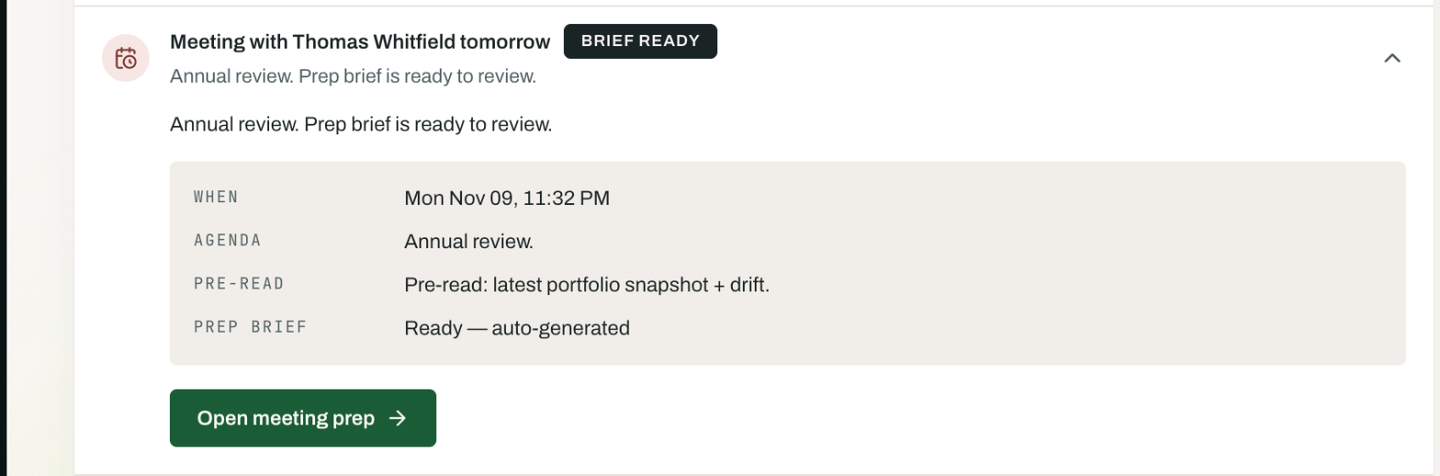
The brief arrives before the advisor goes looking for it. A meeting on the first screen carries a Brief ready tag, and the meeting prep agent has already written the brief by the time the advisor opens it.
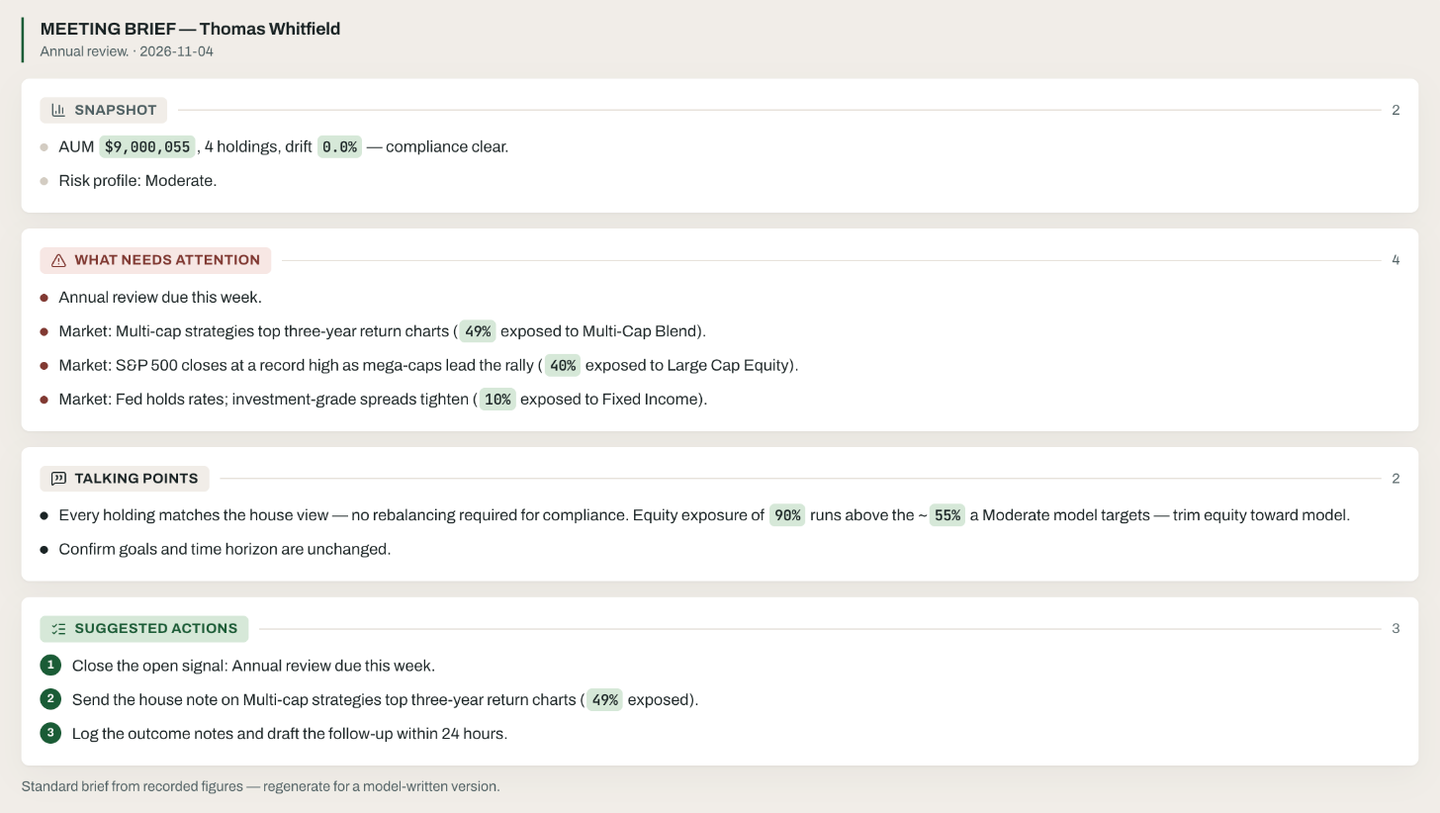
The brief has four parts. A snapshot gives the assets, the number of holdings, how far the portfolio has drifted and whether compliance is clear. What needs attention lists the review that is due and the market moves that touch this client's exposures. Talking points follow, and suggested actions close the brief, each one something the advisor can accept, amend or discard.
After the meeting it turns the conversation into a CRM note, the commitments each side made and action items routed with a date, and each item is proposed for approval before it is written to any system. The advisor decides and the agent prepares.
It reads from and writes to the CRM, portfolio, planning and email systems the firm already runs, so a firm adds the brief without replacing any of them.
See Pravar working inside your company.
How long does AI meeting prep take?
It depends on the firm and the data. KPMG reports a 50% cut in preparation time in one client case, so time your own baseline before and after a pilot.
What data does an AI meeting brief need?
The CRM, the portfolio system, the plan and the last conversation, and a firm should ask the vendor which of them it reads and which it writes to.
Should the client see the brief?
That is a firm decision, since the brief is an internal working document for the advisor.